

Introduction
The survival of a business across centuries is rare. Wars, economic crises, technological disruption, political upheaval, and shifting consumer tastes eliminate even the most powerful firms. Yet a handful of companies have endured for hundreds—sometimes more than a thousand—years. Their longevity offers insight into resilience, adaptability, governance, and cultural continuity. Below are ten of the oldest companies in the world that are still operating today, each representing a remarkable case study in endurance.
1. Kongo Gumi (Founded 578, Japan)
Sector: Construction
Established: 578
Kongo Gumi is widely recognized as the world’s oldest continuously operating company. Established in 578, the firm specialized in building Buddhist temples. For more than 1,400 years, it remained under family leadership across dozens of generations.
The company constructed significant historical structures, including Osaka’s Shitennoji Temple. Even after periods of economic turmoil in Japan, including the modernization wave of the nineteenth century and the economic stagnation of the late twentieth century, the business adapted. In 2006, after financial difficulties, it became a subsidiary of a larger construction firm, yet it continues to operate under its historic name.
Its longevity reflects specialization, craftsmanship, and the ability to evolve while preserving core expertise.
2. Nishiyama Onsen Keiunkan (Founded 705, Japan)
Industry: Hospitality
Founded: 705
Running as a hot spring hotel since 705, Nishiyama Onsen Keiunkan has welcomed visitors for upwards of 1,300 years. Situated close to Mount Fuji, the property has remained under the stewardship of the same family for over 50 generations.
The property has welcomed both prominent historical figures and contemporary guests. Even amid significant technological and cultural shifts, the establishment preserves its classic hospitality ethos while seamlessly incorporating modern conveniences. Its remarkable longevity is rooted in an exceptional setting, unwavering excellence, and continuous family management.
3. Stiftskeller St. Peter (Founded 803, Austria)
Industry: Hospitality and Dining
Founded: 803
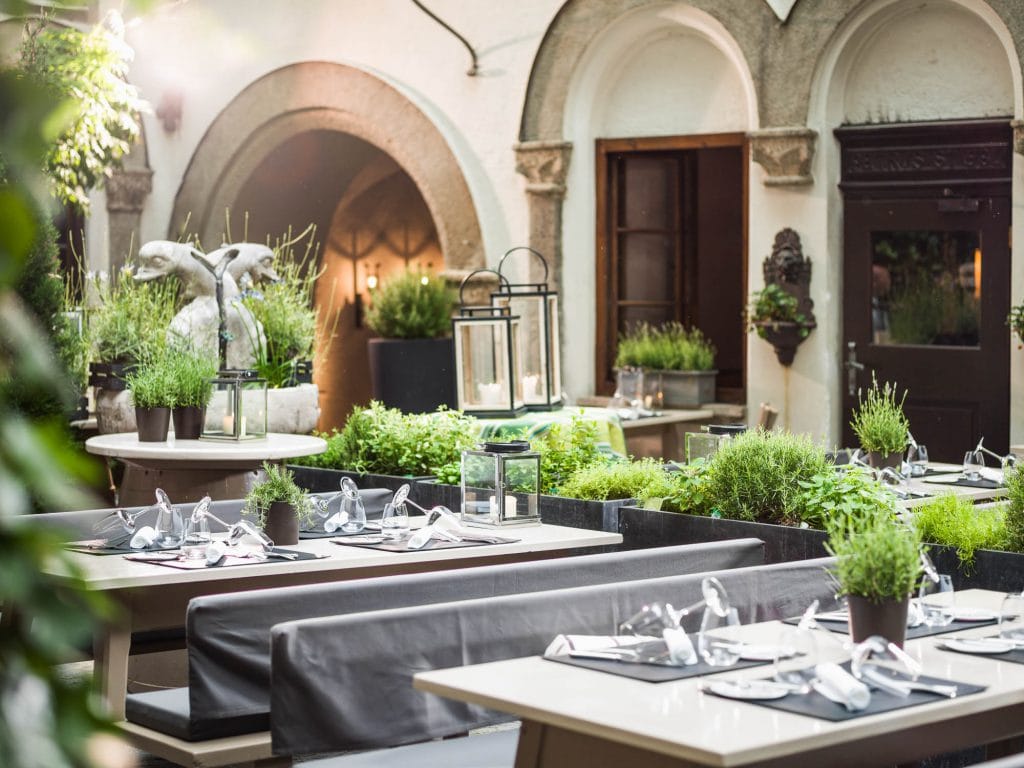
Located inside a Salzburg monastery, Stiftskeller St. Peter boasts a legacy spanning over 1,200 years of uninterrupted service. Archival documents dating back to the early 800s bear witness to its long-standing presence.
The restaurant blends heritage with contemporary dining experiences. It serves both locals and international visitors, leveraging its historical setting as a unique value proposition. Tourism, branding, and preservation of cultural heritage have sustained its relevance.
4. Staffelter Hof Winery (Founded 862, Germany)
Industry: Wine Production
Founded: 862
Staffelter Hof, located along the Mosel River, has been producing wine since 862. Originally owned by an abbey, it later transitioned into private ownership.
The winery demonstrates how agricultural enterprises can survive through land stewardship and generational knowledge transfer. By adapting to global wine markets and modern distribution methods, it balances tradition with commercial viability.
5. Sean’s Bar (Founded 900, Ireland)
Industry: Hospitality
Founded: 900
Recognized as one of the oldest pubs in Europe, Sean’s Bar in Athlone has welcomed patrons for more than 1,100 years. Archaeological evidence confirms its early origins.
Its endurance depends on community embedding. Functioning as a social nucleus, it progressed alongside the economic and cultural transformations of Ireland. While historical components were safeguarded through refurbishments, contemporary management maintains financial viability.
6. Monnaie de Paris (Founded 864, France)
Industry: Minting and Manufacturing
Founded: 864
The Monnaie de Paris functions as the official mint of France, standing proudly among the oldest continuously running public institutions globally dedicated to the craft of coin manufacturing.
It has produced currency through monarchies, revolutions, empires, and republics. Its survival reflects state support, institutional adaptation, and diversification into commemorative coins and collectible art pieces.
7. Tanaka Iga (Founded 885, Japan)
Industry: Religious Goods Manufacturing
Founded: 885
Tanaka Iga specializes in producing Buddhist religious goods. For more than 1,100 years, it has served temples and practitioners.
The firm’s concentration on a specialized sector characterized by steady cultural need has proven vital to its longevity. In Japan, religious persistence generated a reliable and enduring market for its goods.
8. Royal Mint (Founded 886, United Kingdom)
Industry: Minting
Founded: 886
The Royal Mint has produced coinage for over 1,100 years. As an institution closely tied to governance and economic systems, it has evolved alongside the British state.
At present, it mints circulation coins for various nations while also crafting bullion alongside commemorative pieces. Its expansion past national money bolsters endurance within a digital financial system.
9. Barone Ricasoli (Founded 1141, Italy)
Industry: Wine Production
Founded: 1141
Barone Ricasoli, established in 1141, is among Italy’s oldest wineries. The Ricasoli family played a key role in defining the formula for a prominent Italian wine style during the nineteenth century.
Despite armed conflicts and financial fluctuations, the estate modernized its manufacturing methods, broadened its foreign shipments, and poured resources into brand development. Its enduring presence demonstrates how vital it is to blend innovation with heritage.
10. Shore Porters Society (Founded 1498, Scotland)
Industry: Logistics and Moving Services
Founded: 1498
Established in Aberdeen, the Shore Porters Society started out as a collective of dock workers. Across more than five hundred years, it transformed into a contemporary moving and storage enterprise.
Its cooperative framework and capacity to pivot from manual port operations toward all-encompassing logistics solutions highlight a strategic reinvention. Shared responsibility and forward-looking planning are strongly underscored by the firm’s governance model.
Common Traits Behind Centuries of Survival
Although these companies span industries and regions, several shared characteristics explain their longevity:
- Adaptability: Every single enterprise successfully navigated technological, political, and market shifts.
- Strong Governance: Continuity was guaranteed through family stewardship, cooperative models, or state support.
- Specialization: A significant number concentrated on niche mastery to maintain their market relevance.
- Cultural Integration: Stable demand was generated by deep-seated ties to local communities or religious traditions.
- Brand Heritage: Historical legacy evolved into a powerful strategic resource.
Lessons for Modern Businesses
Modern startups often prioritize rapid scaling, yet these ancient enterprises demonstrate a different model of success. Sustainable growth, prudent financial management, and intergenerational thinking frequently matter more than short-term expansion. Diversification without abandoning core competencies also appears crucial.
Companies such as Kongo Gumi and the Royal Mint show that even institutions rooted in tradition must embrace structural change to survive economic disruption. Meanwhile, hospitality businesses like Nishiyama Onsen Keiunkan prove that experience-based value can transcend centuries when service excellence remains consistent.
The existence of companies older than many nations challenges assumptions about corporate lifespan. Their stories reveal that endurance is rarely accidental; it is built on adaptability, disciplined management, cultural alignment, and the careful transfer of knowledge across generations. These enterprises stand not only as commercial entities but as living bridges between past and present, demonstrating that longevity in business is less about resisting change and more about mastering it.



.jpg "Key compliance requirements for maintaining a Panama offshore company")